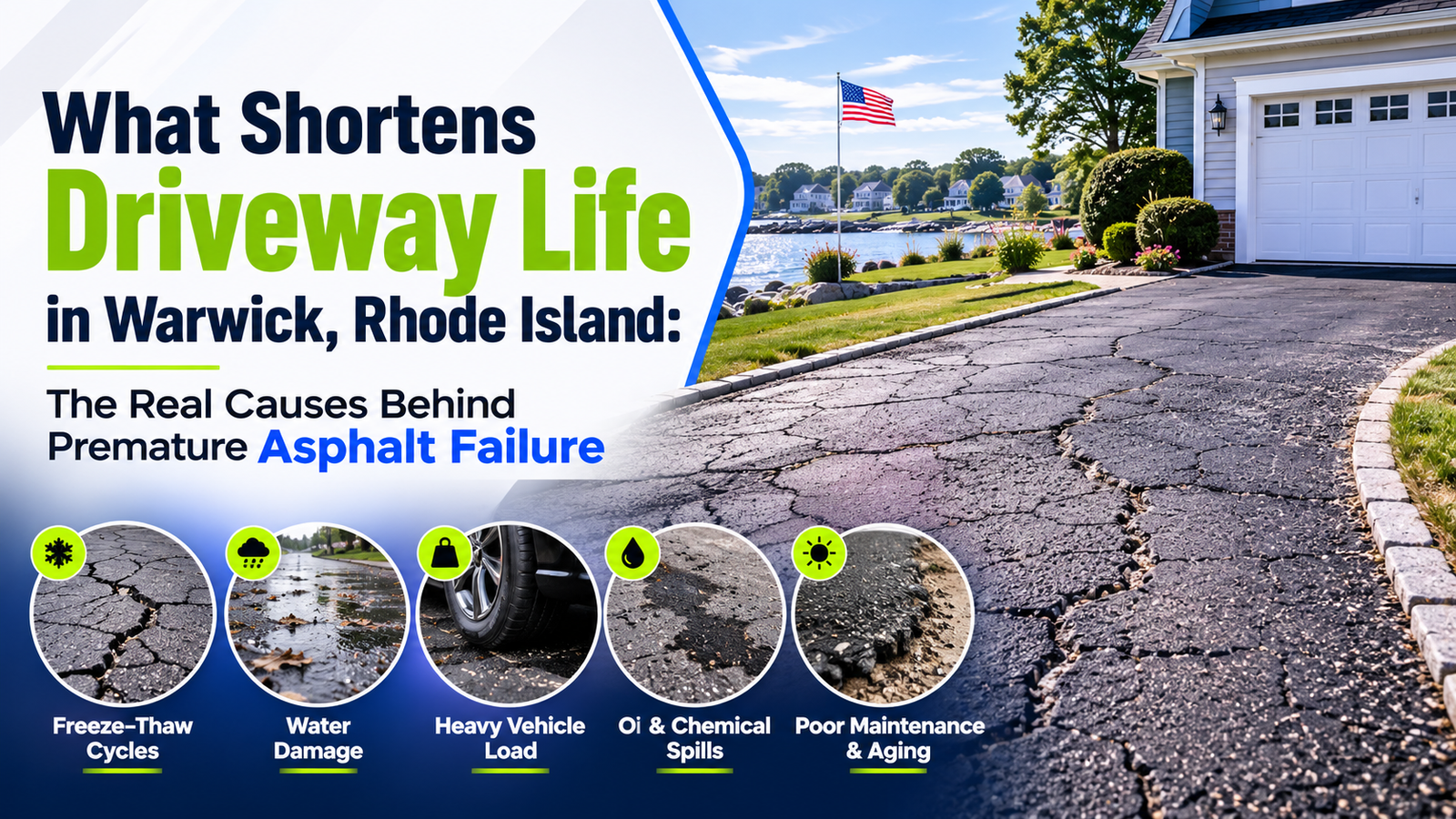
A properly installed asphalt driveway in Warwick, Rhode Island should last 20 to 25 years with reasonable maintenance. Yet Shorten Driveway Life Warwick throughout Kent County deteriorate significantly within 10 to 12 years sometimes less leaving homeowners facing replacement costs they were not expecting. The difference between a driveway that reaches its designed lifespan and one that falls short is almost never random. Premature asphalt failure in Warwick has specific, identifiable causes that operate systematically on driveways throughout the city and surrounding Rhode Island communities. Understanding these causes and recognizing which ones are actively shortening the life of your specific driveway is the most direct path to making decisions that protect your pavement investment.
The Rhode Island Freeze-Thaw Cycle: The Dominant Driveway Destroyer
No single factor shortens asphalt driveway life in Warwick more consistently or more powerfully than the freeze-thaw cycle. Rhode Island’s climate produces some of the most damaging freeze-thaw conditions in the northeastern United States. The state experiences 30 to 50 or more freeze-thaw cycles per winter transitions from below-freezing temperatures back above 32 degrees Fahrenheit and these cycles are the primary mechanism by which water destroys asphalt pavement from within.
The physics are straightforward and relentless. Water enters the asphalt surface through existing cracks, pores, and micro-fissures in the pavement. When overnight temperatures drop below freezing, that water expands by approximately nine percent as it converts to ice. This expansion exerts hydraulic pressure on the surrounding pavement structure crack walls are pushed apart, surrounding aggregate is displaced, and the bond between asphalt components is weakened. When temperatures rise above freezing the next day, the ice melts, the water moves deeper into the structure, and the process repeats with the next freeze cycle.
Each individual freeze-thaw event causes incremental damage. Over 40 or 50 cycles in a single Warwick winter, this incremental damage accumulates into visible surface cracking, base weakening, and eventually the structural failure that produces potholes. The damage progresses faster than most homeowners expect because it is happening underground the subbase is weakening long before the surface shows the visible signs that prompt action.
This is why Warwick paving contractors emphasize crack sealing before winter more than maintenance professionals in warmer climates do. Every crack sealed before the first freeze removes one water entry pathway. Every pathway sealed reduces the freeze-thaw damage that accumulates over the winter. Driveways with sealed crack networks enter each winter in a fundamentally more protected state than those with open cracks and in Rhode Island, that difference is measured in years of driveway life.
Inadequate Subbase: The Installation Failure That Shortens Life from Day One
The most consequential factor in driveway longevity is one that is invisible and established on the day of installation: the depth and quality of the aggregate subbase beneath the asphalt. In Warwick’s climate, Rhode Island paving standards call for a minimum of six to eight inches of compacted gravel base beneath residential asphalt. This base distributes the loads of vehicles through the asphalt, provides drainage to prevent water accumulation beneath the surface, and gives the asphalt the stable foundation it needs to resist deflection under traffic.
When the subbase is inadequate either too thin, improperly graded, or insufficiently compacted the asphalt surface above it has no structural support against vehicle loads. The pavement deflects under each vehicle pass, and these repeated deflections fatigue the asphalt from below. The failure pattern that results is alligator cracking: the network of interconnected cracks forming polygonal shapes resembling reptile skin, which is the surface manifestation of base failure. Alligator cracking cannot be fixed from the surface once it appears, the base has already failed and resurfacing alone will not solve the problem.
The frustrating reality is that inadequate subbase installation is invisible until it is too late. A driveway paved over insufficient base looks identical to one paved over a properly prepared base on the day of installation. The difference only becomes apparent years later, when the inadequately supported driveway begins to fail significantly earlier than a properly installed one. This is why choosing a Warwick paving contractor who specifically discloses the base depth and material specification rather than simply providing a surface-level scope is so important for long-term results.
Subbase failure in Warwick is accelerated by the region’s frost depth. Rhode Island’s design frost depth the depth to which the ground freezes during a cold winter is approximately 36 to 48 inches. When the ground freezes to depth, ice lenses can form in frost-susceptible soils beneath the pavement, causing frost heave that disrupts the pavement structure from below. A properly designed Warwick driveway uses non-frost-susceptible aggregate materials below the frost zone to prevent this heave from occurring.
UV Oxidation: The Year-Round Aging Process
While freeze-thaw cycling gets most of the attention as a driveway killer in New England, UV oxidation operates continuously and relentlessly throughout all four seasons in Warwick. Asphalt’s dark color and petroleum-based binder make it vulnerable to the ultraviolet radiation in sunlight, which initiates a chemical process called oxidation that progressively hardens and embrittles the binder.
Fresh asphalt binder is a semi-flexible material that holds aggregate particles together while accommodating minor deflections and thermal expansion without cracking. As UV radiation drives oxidation over months and years, the binder loses this flexibility. The surface transitions from near-black to progressively lighter gray a color change that is visible and that signals ongoing binder degradation. Oxidized binder is brittle binder, and brittle binder cracks under the thermal stresses of Warwick’s temperature range and under vehicle loads that flexible asphalt would accommodate without cracking.
Sealcoating is the primary intervention against UV oxidation. A quality coal tar or asphalt-based sealcoat applied over the driveway surface forms a protective film that absorbs and reflects UV radiation before it can reach the asphalt binder. Warwick driveways that are sealcoated on a regular schedule every three to five years for residential driveways maintain binder flexibility significantly longer than unsealed driveways exposed to the same UV loading. The visual difference is also apparent: a sealcoated driveway maintains a dark, fresh appearance while an unsealed one turns progressively grayer and more brittle.
Poor Drainage and Water Accumulation
Water standing on or pooling against an asphalt driveway is a primary accelerator of every other deterioration mechanism. A driveway that drains well with a consistent cross-slope that directs water off the surface and away from the house foundation manages rainfall without accumulation. A driveway that has settled, has inadequate pitch, or collects water against its edges creates conditions where water can infiltrate the surface and reach the base layer.
In Warwick’s climate, drainage is doubly important because water that infiltrates the base does not simply cause drainage problems it provides the water that fuels freeze-thaw damage in winter. Every time water accumulates against or beneath the driveway surface and then freezes, it expands and damages the pavement structure. Driveways with poor drainage experience more freeze-thaw damage per winter than those that shed water efficiently, simply because more water is present to freeze.
Drainage failures can develop gradually. A new driveway properly sloped at installation may develop low spots over years as the subbase consolidates slightly and uneven settlement occurs. Tree roots growing beneath the driveway can create localized high spots that trap water in adjacent depressions. Landscape changes the addition of mulch beds, retaining walls, or grade changes adjacent to the driveway can redirect water toward the pavement rather than away from it. Warwick homeowners should inspect their driveways after heavy rain events to observe where water is collecting, because drainage problems are usually visible long before they become structural problems.
Road Salt and De-Icing Chemicals
Rhode Island winters require de-icing, and the salt and chemical products applied to Warwick roads and driveways throughout the winter months have a measurable effect on asphalt longevity. While asphalt handles salt exposure better than concrete which is dramatically susceptible to salt-driven scaling it is not immune to the effects of repeated chemical exposure.
The primary mechanism of salt damage to asphalt is indirect: chloride-based de-icing products lower the freezing point of water, which increases the number of freeze-thaw cycles that occur during a given winter. A temperature window that without salt would produce one freeze-thaw cycle might produce two or three with de-icing products present, multiplying the mechanical damage from freezing and thawing. Road salt applied to public streets adjacent to Warwick driveways is tracked onto the driveway surface by vehicles, extending the de-icing product’s influence well beyond the street itself.
De-icing chemicals also penetrate asphalt’s surface voids and can reach the aggregate-binder interface, weakening the bond between asphalt particles over time. High-quality sealcoating reduces this penetration by filling surface micro-voids and providing a chemical-resistant barrier. Sealcoating before winter is particularly valuable for this reason it reduces both water infiltration and de-icing chemical penetration during the season when both forces are most active and most damaging.
Heavy Vehicle Loads Beyond the Design Capacity
Residential asphalt driveways in Warwick are designed for passenger vehicle loading the standard residential driveway pavement section of three inches of asphalt over six to eight inches of compacted base is appropriate for cars, small trucks, and SUVs in the 3,000 to 6,000 pound range. When heavier vehicles regularly use a residential driveway, the pavement is being loaded beyond its design capacity, and premature failure is the predictable result.
The most common heavy vehicle scenarios for Warwick residential driveways include moving trucks, which can weigh 26,000 pounds or more when fully loaded, concrete delivery trucks, oil delivery trucks, garbage trucks, and recreational vehicles or boat trailers. A single pass by a fully loaded moving truck applies roughly five times the load of a passenger vehicle and load damage to asphalt is not linear but exponential. The AASHTO fourth-power law establishes that load damage increases with the fourth power of the axle load, meaning that a doubling of axle load produces sixteen times the pavement damage per pass.
Property owners cannot always control what heavy vehicles access their driveway, but awareness of the damage mechanism helps set realistic expectations. A driveway that sees one or two heavy vehicle deliveries per year will not fail from those events alone. A driveway used routinely by a heavy truck or recreational vehicle will wear significantly faster than one used exclusively by passenger vehicles, and the maintenance program should reflect that reality.
Deferred Maintenance: The Most Controllable Shortener
If freeze-thaw cycling and subbase quality are the factors most outside a homeowner’s control, deferred maintenance is the factor most within it and it is one of the most significant causes of premature driveway failure throughout Warwick. The relationship between maintenance deferral and accelerated failure is direct: every small crack that is not sealed promptly becomes a larger crack that allows more water infiltration. Every maintenance cycle missed exposes the asphalt binder to additional UV oxidation and weathering. The cost of maintenance deferred consistently compounds over time, eventually reaching the point where the driveway cannot be maintained to a serviceable condition and must be replaced entirely.
Industry data consistently supports the value of proactive maintenance. Studies of asphalt pavement lifecycle costs demonstrate that pavement in good condition can be maintained at a fraction of the cost that the same pavement requires once it has deteriorated to poor condition. The optimal investment point where maintenance is most efficient and cost-effective is before significant deterioration occurs, not after it is visible and advanced. Waiting to “see what happens” over another winter is almost always the more expensive choice when surface damage is already present.
For Warwick homeowners, the practical maintenance program that prevents premature driveway failure is: sealcoating every three to five years, crack sealing whenever cracks develop and particularly before each winter season, and professional assessment of any surface distress that appears unusual or is spreading rapidly. This program is not expensive relative to replacement maintaining a Warwick driveway in good condition costs a fraction of replacing it, and the replacement timeline with consistent maintenance extends significantly beyond the replacement timeline without it.
Tree Roots: The Underground Force Property Owners Underestimate
In Warwick’s established residential neighborhoods, mature street trees and large landscape trees represent one of the most underestimated threats to driveway longevity. Tree root systems extend horizontally far beyond the canopy drip line in many common street tree species, root extension can reach two to three times the canopy radius. As these root systems grow in diameter over years and decades, they exert sustained upward pressure against any pavement above them.
The resulting damage manifests as raised ridges, buckled sections, and linear cracking that follows the root path rather than the random pattern of thermal cracking. Root-driven damage is distinguishable from freeze-thaw damage by its pattern it follows a relatively straight line aligned with nearby trees rather than the more random distribution of thermal shrinkage cracking.
Repairing root-heaved driveway sections without addressing the underlying roots produces results that fail quickly the roots continue growing, and the new pavement is heaved within two to three years. Effective repair requires root pruning or root barrier installation as part of the repair scope, and in some cases consultation with an arborist about the long-term compatibility of the tree with a paved surface in that location.
Common Questions About What Shortens Driveway Life in Warwick
What is the most damaging thing I can do to my Warwick driveway? Allowing water to infiltrate through open cracks during freeze-thaw cycling is the single most damaging ongoing process. Sealing cracks before winter prevents the primary damage mechanism from operating throughout the season. Beyond crack sealing, avoiding heavy vehicle loading and maintaining sealcoat coverage are the next most impactful protective actions.
How many years of life does sealcoating add to a Warwick asphalt driveway? Consistent sealcoating at three-to-five-year intervals, combined with prompt crack repair, can add five to ten or more years to the functional life of a Warwick asphalt driveway compared to an identical unsealed driveway. Some industry estimates suggest that regular sealcoating can extend driveway life by 30 to 50 percent, though actual results depend on traffic loading, subbase quality, and drainage conditions specific to each property.
If my Warwick driveway was installed with insufficient subbase, can it be corrected without full replacement? Partial deep patching removing and replacing failed sections with properly supported new asphalt can address localized base failure. Widespread base failure throughout a driveway cannot be corrected without full removal and reconstruction. This is why subbase adequacy at installation is the most consequential single factor in driveway longevity, and why getting it right on the original installation matters so much.